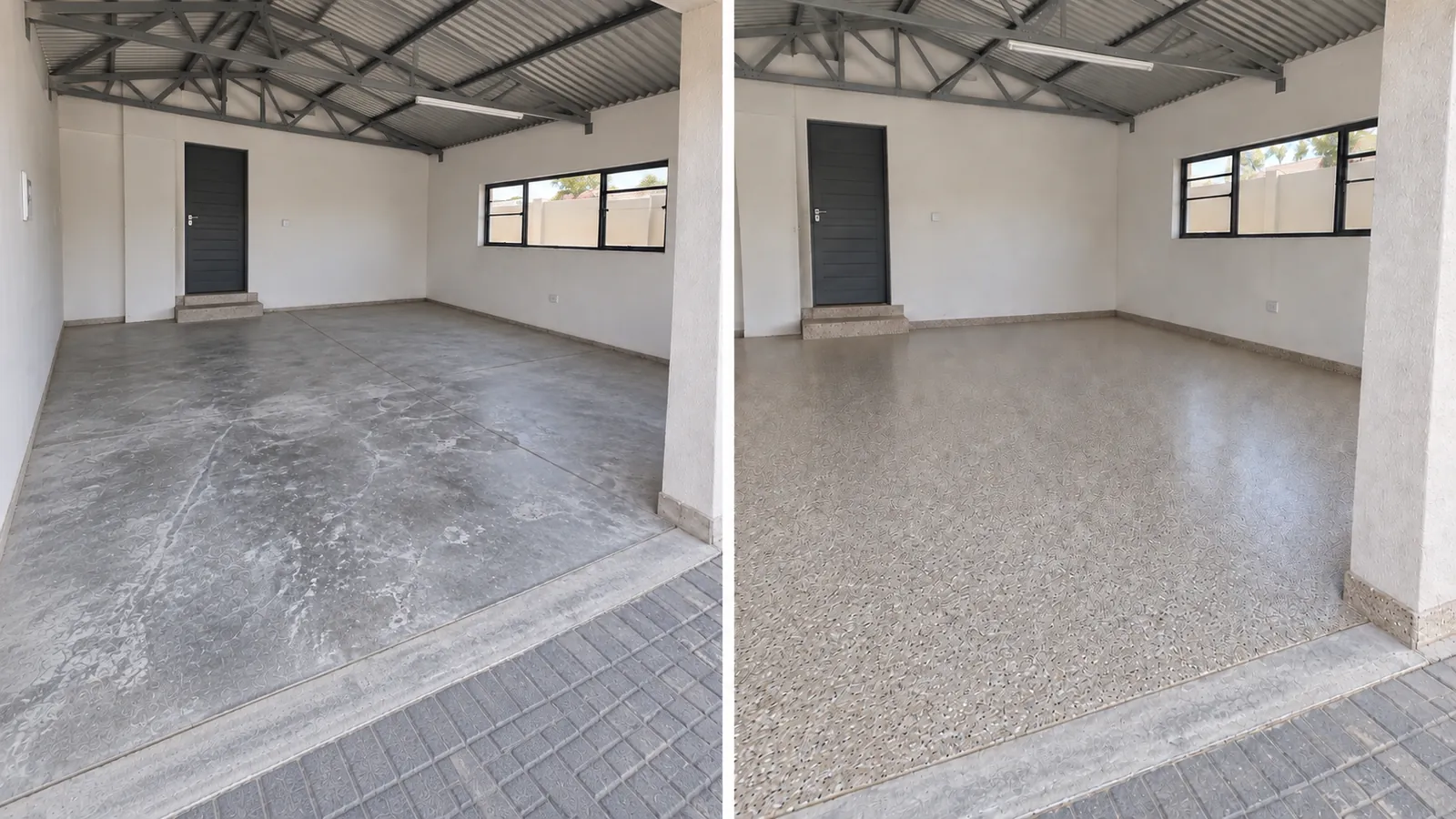
A real Botswana garage, taken from bare concrete to a finished multi-colour flake epoxy floor. Here's how our crew approached it on site.
This garage started as raw, dusty concrete — the kind found under most Botswana homes once the builder hands over. The brief was straightforward: a durable, easy-to-clean floor that could take vehicle traffic, oil drips and daily wear, finished to look like more than a poured slab.
A flake floor is built up in stages, and each stage has to be right before the next one goes down. This is the standard sequence for a garage flake installation.
The slab is diamond ground to remove surface laitance and open the concrete for adhesion, then cleared of dust.
A waterbased epoxy primer seals the prepared concrete and provides a sound base for the coats that follow.
A pigmented epoxy basecoat is rolled out to give the flake blend a consistent, even background colour to sit on.
The flake blend is broadcast into the wet basecoat by hand, working for full, even coverage across the floor.
Once loose flake is cleared, the correct topcoat for the environment is applied and left to cure, sealing the floor for durability, chemical resistance and gloss.
A flake floor does more than look good. The broadcast flake adds texture underfoot for slip resistance, and it hides the everyday marks of garage life — tyre scuffs, light dust, small tool drops — far better than a flat single colour ever will.
The topcoat is what makes it practical day to day: it resists oil, brake fluid and coolant far better than bare concrete or paint, and it wipes clean rather than staining.
This matters more than most people expect, and it's specified based on where the floor actually sits.
For a garage that's covered and out of direct sunlight, a standard epoxy topcoat is the right call — tough, chemical-resistant, and cost-effective. Epoxy is not UV-stable on its own and will yellow with sustained direct sun exposure over time, but that's not a concern under a roof.
Where the flake floor extends into a carport, open-sided area, or anywhere that sees direct sunlight, we specify a UV-stable topcoat — a polyaspartic or aliphatic polyurethane finish — instead of standard epoxy. These hold their colour and gloss under UV exposure rather than yellowing or chalking.
A flake floor is not a paint. It is a built-up system, and each layer is doing a specific job. This is what the build-up looks like and why nothing in it is optional.
Each stage has its own cure time before the next can go on, which is why a garage floor is a multi-day job rather than an afternoon. The same build-up, at heavier duty, is what goes into an industrial or warehouse floor. Curing cannot be shortened, and a floor pushed back into service early is the most common way a good system gets damaged.
Domestic garage slabs are rarely laid with a coating in mind. These are the four things that change the specification and the price.
How long before I can park on it?
Foot traffic is typically possible the day after the final coat, but vehicles are the harder test. A car standing on a floor that has not fully cured will mark it, and hot tyres will lift a coating that is still curing. We give a specific date at quotation stage against the system and the conditions, and it is not a figure worth rushing.
What is hot tyre pickup and will it happen to my floor?
When a car is driven, the tyres heat up and soften. Parked on a coated floor, a hot tyre can bond to a coating and pull it off the slab when the car is next moved. It is a known failure mode for thin, single-coat garage paints. It is managed by correct mechanical preparation, a properly primed substrate, adequate film build and full cure before the car goes back in, not by any single product claim.
Can you go over the paint that is on there now?
Only after we know what it is and how well it is stuck down. Most garage floor paint is a thin coating that was rolled onto an unprepared slab, and it will come off with the new system attached to it. In most cases it is mechanically removed by grinding. Where an existing coating is sound and well bonded, it can sometimes be abraded and overcoated.
My garage slab gets damp. Is that a problem?
It can be a serious one. Resin systems are effectively impermeable, so moisture rising through a slab has nowhere to go and will push the floor off. Slab-on-grade construction without an effective damp-proof membrane is the usual cause. It is testable before anything is committed, and there are primer systems for damp substrates, but it has to be identified first rather than discovered afterwards.
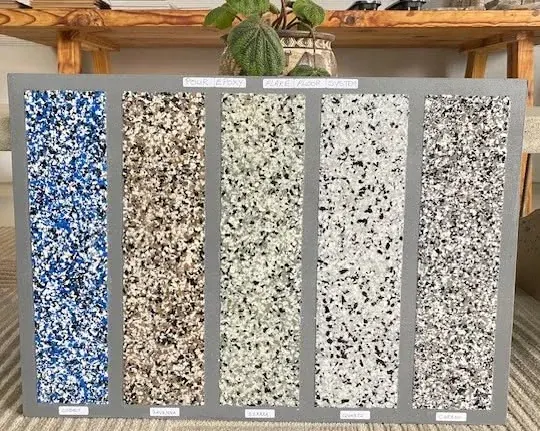
Can I choose the flake colour?
Yes. Flake is supplied in blends, and the blend, the flake size and how heavily it is broadcast all change the look. A full broadcast gives a dense, uniform finish that hides slab imperfections well; a lighter scatter shows more of the base colour. We will show you the options before anything is ordered.
How much mess does it make?
Grinding is the messy part. We use dust-extracted grinding equipment, but a garage that adjoins the house should be sealed off at the doorway, and anything stored in it needs to be out before we start. The resin stages are clean by comparison but do have a smell during application and cure, so ventilation matters.
Tell us about your space and we'll talk you through colour options, system choice and what to expect on installation day.