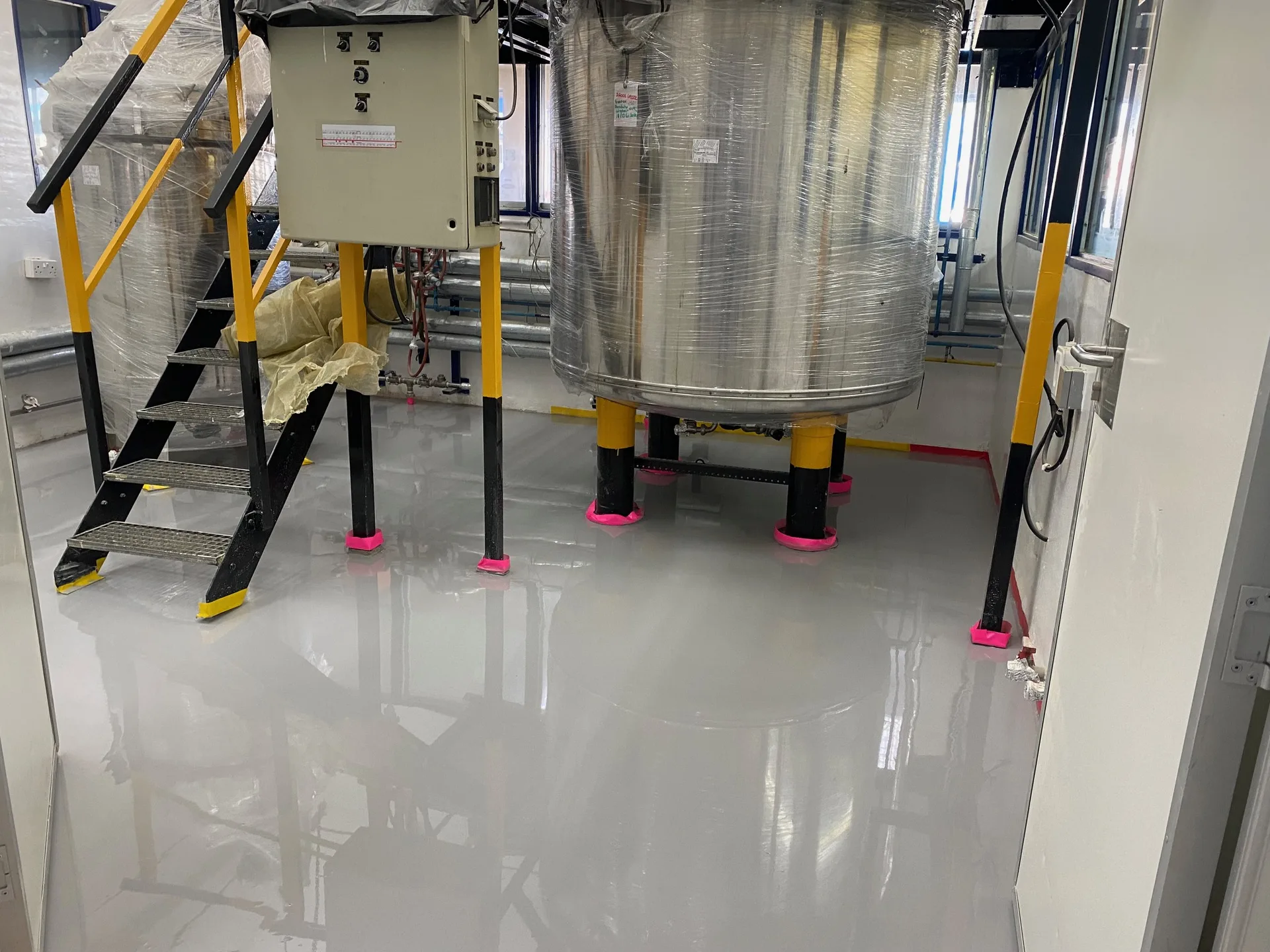
Where epoxy meets its limits — thermal shock, sustained moisture and heavy wash-down — polyurethane is the system built to handle it.
Epoxy is hard and chemically tough, but it's also relatively rigid — and rigid coatings can crack or delaminate in floors that move with temperature. Polyurethane binders stay flexible across a much wider temperature range, so the coating moves with the substrate instead of fighting it.
That flexibility is exactly what environments with steam cleaning, cold rooms, or ovens next to wash-down bays need. It's also why polyurethane holds up better than epoxy in floors that go from hot to cold, or wet to dry, several times a day.
A tough, single-pack polyurethane coating for chemical splash and general abrasion resistance, applied at a coverage of 5–8 m² per litre. Light traffic can return to the floor overnight, with heavier traffic after three days. A practical option for upgrading or recoating an existing floor.
A multi-functional, solvent-free polyurethane system built for exceptional impact and abrasion resistance. Applied by roller for a standard high-build finish or trowelled up to 800 micron film thickness where heavy impact resistance is the priority.
A trowelled polyurethane screed for medium to heavy-duty environments, available at different film thicknesses depending on load and traffic. Always installed over the correct epoxy or PU primer to achieve proper adhesion to the substrate.
Both are resin systems, but they suit different conditions. We specify based on your actual environment, not a default choice.
The floor sees stable temperatures, high compressive loads, and chemical exposure without repeated thermal shock — typical of warehouses, workshops and most retail or commercial floors.
The floor is subject to temperature swings, steam cleaning, or continuous moisture — typical of food production, cold storage and any environment with heavy wash-down.
Polyurethane floor screeds are specified by thickness, and thickness is what determines the temperature range, the traffic they will take and the cost. These are the Technical Finishes PolyScreed systems we install.
| System | Thickness | Service temperature | Finish | Suited to |
|---|---|---|---|---|
| PolyScreed LockCoat | 0.25 mm | −5 °C to 80 °C | Roller-applied coat | Overcoating sound concrete or existing PU screed |
| PolyScreed SL | 2.5 mm | −5 °C to 60 °C at 2 mm | Smooth, self-smoothing | Light to medium traffic, dry production and packing |
| PolyScreed MD | 4 mm | −15 °C to 90 °C at 4 mm | Smooth, self-smoothing | Medium traffic, food and pharmaceutical production |
| PolyScreed UT | 5 mm | −15 °C to 100 °C at 5 mm | Textured, slurry broadcast | Wet process areas needing positive grip underfoot |
| PolyScreed RT | 6–8 mm | −15 °C to 110 °C at 8 mm | Lightly textured, rake and trowel | High traffic volume, food and manufacturing |
| PolyScreed HF | 8–10 mm | −40 °C to 110 °C | Heavy-duty screed | Freezer rooms, thermal shock, high traffic volumes |
Figures are Technical Finishes’ published manufacturer data. We confirm the final specification against the current data sheet before quoting, as formulations and published figures are revised from time to time.
Across the screed range the manufacturer gives a compressive strength above 50 MPa, flexural strength above 20 MPa, Shore D hardness of 80, foot traffic at 12 to 16 hours and heavy traffic at 24 hours. All are HACCP compliant with antimicrobial silver ion technology.
The table covers the duty levels we specify most often. The PolyScreed range extends further — power-trowelled coloured quartz and terrazzo finishes where appearance matters, static-dissipative grades for electronics and pharmaceutical areas, and PU mortar for the heaviest duty. If your environment does not fit neatly into the table above, it is worth a conversation rather than a guess.
Polyurethane costs more than epoxy. These are the four conditions where that difference is worth paying, and where an epoxy floor will give trouble.
If none of those four apply to your building, epoxy is very likely the more sensible specification, and we will tell you so. The industrial and warehouse flooring page covers where each system belongs.
What is the difference between a polyurethane screed and an epoxy coating?
Thickness and behaviour. An epoxy coating is applied at a few hundred microns and is hard and rigid. A polyurethane screed is applied at millimetres, carries load in its own right, and expands and contracts closer to the rate of the concrete beneath it. That last point is why polyurethane survives thermal shock where a rigid coating would crack or debond.
Do I need polyurethane, or would epoxy do?
Epoxy is well suited to warehouses, workshops, garages and commercial floors that stay at roughly ambient temperature and are cleaned conventionally. Polyurethane earns its extra cost where there is hot washdown or steam cleaning, sub-zero operation, thermal cycling, aggressive chemicals, or a food or pharmaceutical hygiene requirement. If none of those apply, epoxy is usually the sensible specification.
What does HACCP compliant mean in practice?
It means the material is suitable for use in food production environments under a Hazard Analysis and Critical Control Points regime. The PolyScreed systems we install are HACCP compliant and carry antimicrobial silver ion technology. That is a property of the product as supplied; the hygiene outcome on site also depends on detailing, coving and the cleaning regime.
Can polyurethane go over an existing floor?
Over sound, well-bonded existing polyurethane or concrete, often yes. PolyScreed LockCoat is a roller-applied polyurethane coat designed for exactly that, at 0.25 mm and roughly 14 m2 per kit. Over an unknown, contaminated or delaminating coating, no: it has to come off first, because the new system can only be as sound as what it is bonded to.
How much temperature can it actually take?
It depends on thickness, not just on the product. PolyScreed HF at 8 to 10 mm is rated by the manufacturer from minus 40 C to 110 C. The same range at 2.5 mm is rated minus 5 C to 60 C. PolyScreed RT shows the same effect within one product: minus 5 C to 90 C at 6 mm, minus 15 C to 110 C at 8 mm. Specify the thickness for the temperature the floor will actually see, including cleaning.
Tell us about the environment — temperature range, wash-down frequency and chemical exposure — and we'll recommend the right system.